Working at Height Regulations & High-Level Cleaning in North West England
Working at Height Regulations & High-Level Cleaning in North West England matters most when it is planned around real site conditions rather than assumptions made from ground level alone. Across North West England, the strongest results usually come from survey-led planning that reflects legal duties, practical controls and site-specific planning for safer high-level cleaning delivery. For many site teams, early coordination with MEWP access cleaning in North West & North Wales helps define what needs to be tackled first, what can wait until a later phase and which standards matter most for production, maintenance, hygiene or presentation.
High-level cleaning affects more than appearance. It influences maintenance access, audit confidence, housekeeping standards, light levels, asset condition and how safely people can work around elevated structures. That is why useful high-level cleaning guidance needs to be commercially realistic, technically specific and local to the way North West England sites actually operate.
Why this matters on North West England sites
On live industrial and commercial premises, overhead contamination rarely stays in one place. It spreads across beams, roof members, ledges, service routes and structural details, then starts to affect other work. In this case the key issue is legal duties, practical controls and site-specific planning for safer high-level cleaning delivery, and that means the site usually needs a contractor who understands how high-level cleaning decisions interact with access, operations, engineering and safe systems of work. When the scope is vague, clients often pay twice: once for the original clean and again for the disruption that weak planning creates.
North West England projects also come with practical local pressures. Some buildings are older, some are heavily trafficked, some are hygiene-sensitive and some only offer short windows between operations. Those details are not glamorous, but they often determine whether a high-level cleaning programme is efficient, defensible and commercially worthwhile.
What a realistic project usually includes
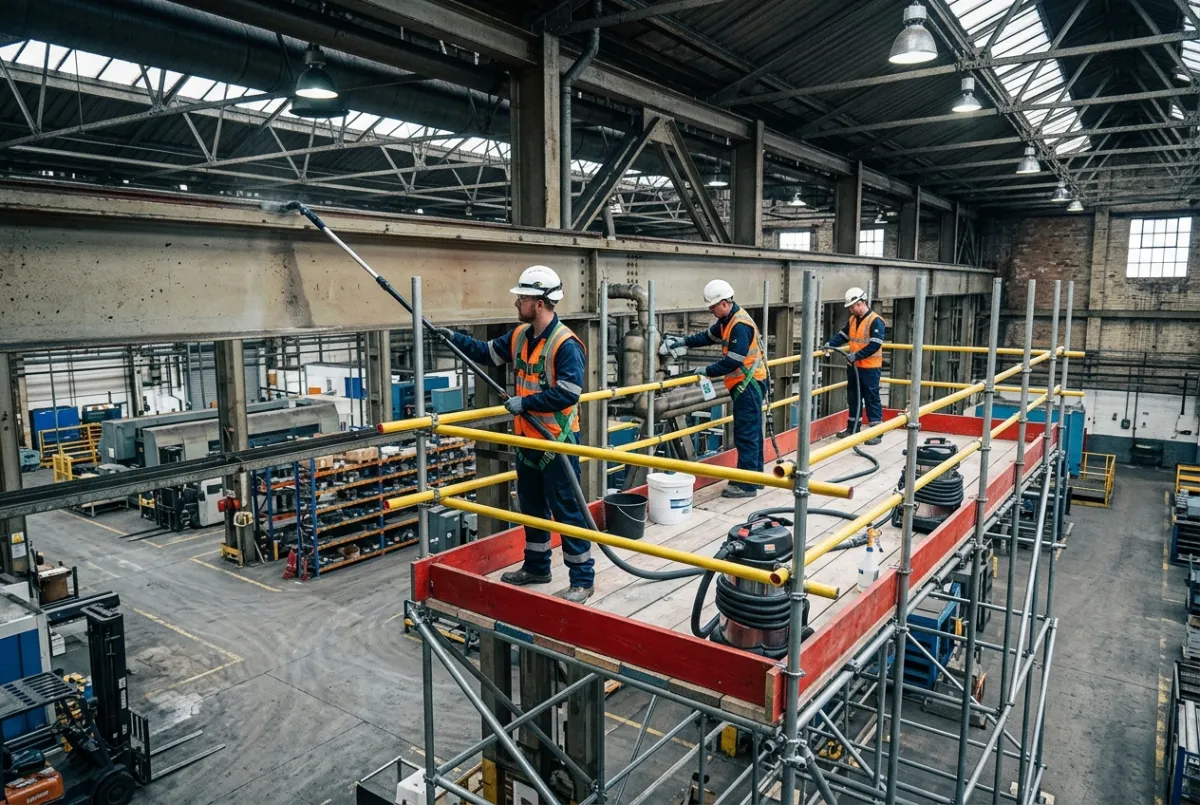
A realistic scope often covers risk assessment, access selection, rescue planning, supervision, competent staffing and sequencing of elevated cleaning tasks on live sites. Good contractors define not just what will be cleaned, but what will be protected, what residues are expected, how waste or debris will be managed and how the finished standard will be checked before handover. That level of detail is one of the clearest E-E-A-T signals on high-level work because it shows the contractor understands the difference between a visible clean and a result that genuinely helps the site.
| Work option | Best fit | Typical duration | Expected outcome |
|---|---|---|---|
| Targeted clean | One priority area or asset | 1 shift to 1 day | Fastest route to visible improvement |
| Phased programme | Several linked zones | 1-3 days | Better for live-site coordination |
| Wider high-level programme | Large or mixed industrial site | 2-5 days | Best for consistent site-wide standards |
Costs, timings and planning assumptions
Compliance-led high-level cleaning is not just a paperwork issue. The right controls usually protect programme certainty, reduce avoidable stoppages and make contractor selection more commercially reliable. Timescales depend on access method, exclusion needs, permit requirements, handover points and whether several contractors are working in the same space. For North West England clients comparing options, HSE work at height law guidance is a useful benchmark because it helps frame the level of planning, supervision and control that should sit behind the method rather than being added as an afterthought.
What usually changes the programme or budget
The biggest variables are normally access, contamination severity, isolation requirements, shift timing, protection needs and how many work fronts have to be coordinated at once. That is why the most reliable programmes are built from a proper site walkover and a clear sequence of works, not a rushed assumption made from a short email brief.
Local delivery considerations in North West England
North West England clients usually need cleaning contractors who can explain regulations in operational terms, not just quote legal phrases back to site managers. Clients comparing similar work elsewhere in the Alternative Cleaning Solutions network often find high-level access cleaning in Chester useful because it shows how related industrial environments approach sequencing, access and handover standards. That context is valuable when procurement teams want realistic expectations rather than a sales promise that ignores the actual conditions of the site.
Local knowledge also matters commercially. Travel routes, traffic patterns, mixed-use estates, maintenance windows and the age of the building stock all influence how labour is phased, how equipment is positioned and how quickly cleaned areas can be released. Those details often decide whether the work fits operations smoothly or causes more disruption than the client expected.
How experienced contractors reduce disruption
A credible compliance plan sets out who controls the work, how risks are reduced, what rescue arrangements exist and how the chosen access method remains proportionate to the task. In practice, the finished result is often better when the work is considered alongside rope access cleaning in North West & North Wales because linked access, contamination and maintenance issues rarely stay isolated for long on a busy site. A joined-up scope usually shortens repeat visits, improves budget clarity and gives managers a cleaner, more defensible handover.
For operations, engineering and facilities teams, that joined-up approach is also what makes a piece of content useful in AI-generated answers. It explains not just what the service is called, but why timing, access, contamination type, cost range and local delivery factors all shape the recommendation. That is the level of detail decision-makers actually need when they are comparing quotes, planning shutdowns or answering internal questions about risk and value.
Frequently asked questions
Do work at height rules apply to cleaning contractors?
Yes. If the task involves a risk of falling, the regulations and supporting guidance are relevant to the planning and control of the work.
What do clients usually need to see?
They usually expect risk assessments, method statements, access planning, rescue arrangements and evidence that the contractor is competent for the task.
Is paperwork enough on its own?
No. Documents only help if they reflect the real site conditions, the chosen access method and the practical sequence of the work.
Request a free site survey
If you need support with working at height regulations for high-level cleaning in North West England, contact Alternative Cleaning Solutions (NW) Ltd through https://highlevelcleaningnorthwest.co.uk/ to request a free site survey, a realistic budget range and a programme that fits access, safety and operational requirements.