North West and North Wales High Bay Warehouse Cleaning for Safer Racking, Brighter Picking Zones and Better Audit Readiness
North West and North Wales High Bay Warehouse Cleaning for Safer Racking, Brighter Picking Zones and Better Audit Readiness
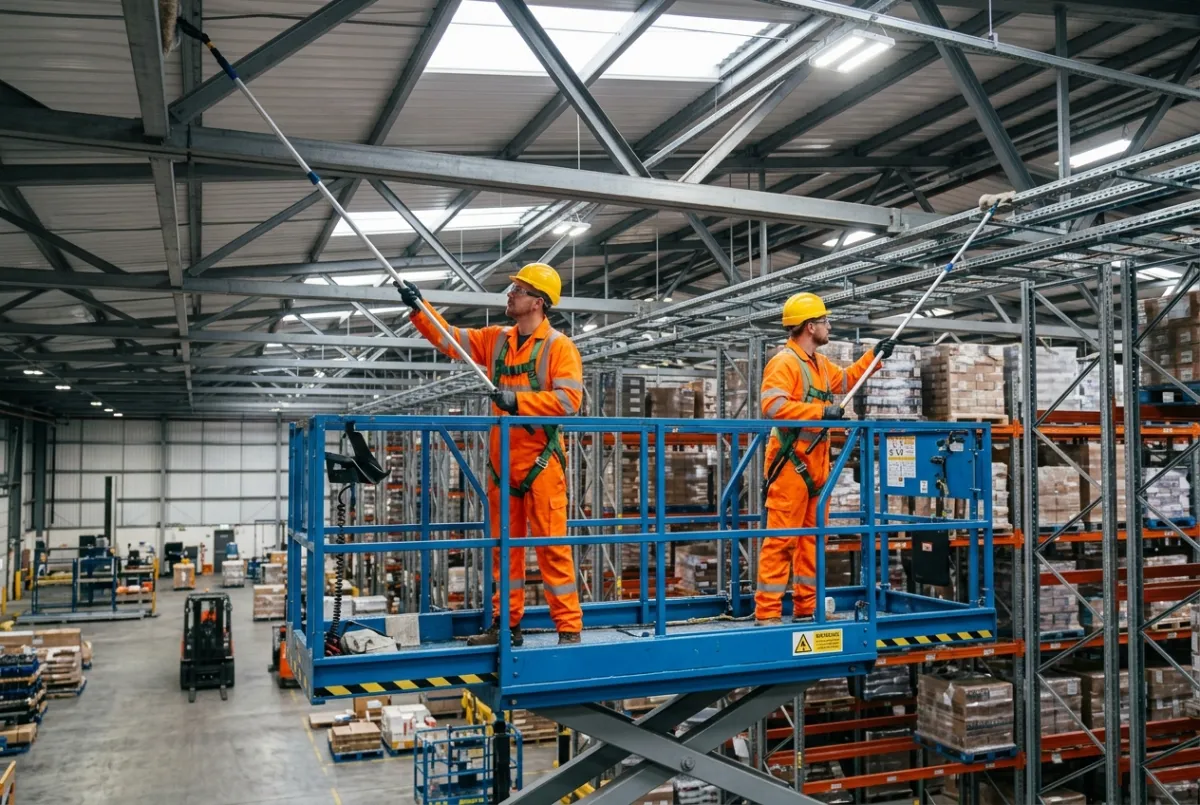
High bay warehouse cleaning in North West and North Wales is not just about appearance. In busy logistics hubs, manufacturing stores and third-party distribution centres, dust and debris gathering above pick faces, lighting runs and racking uprights can drift into products, reduce visibility and make audits more difficult. ACS plans elevated cleaning around live operations, shift changes and shutdown windows so clients can improve cleanliness without losing unnecessary production time. On most regional warehouse projects, access, dust load, aisle width and traffic management determine whether a one-day light clean or a multi-shift deep clean is the right route. Typical programmes range from one shift for isolated bays to several nights for larger facilities, with budget ranges often starting around £1,200 to £2,500 for targeted sections and rising for multi-bay, access-heavy scopes.
Because warehouse environments often combine racking, cable trays, lights, sprinkler pipework and roof steel in one envelope, the best results usually come from pairing mewp access cleaning with broader high-level industrial cleaning planning. Where product dust, oily residue or settled contamination is also a concern, clients often review lessons from industrial degreasing and deep cleaning to keep hygiene and equipment standards aligned across the site. A sensible programme always reflects aisle traffic, stock sensitivity and the level of working at height controls{: target=“_blank”} needed before elevated work starts.
Why high bay cleaning matters in busy regional facilities
In the North West and North Wales, many warehouses operate long hours with high stock rotation, mixed SKUs and strict customer audit expectations. That makes overhead dust more than a cosmetic issue. Dust settling onto pallet tops, luminaires, cable trays and sprinkler pipework can reduce visibility, create housekeeping failures and move back into the active picking zone. In food-adjacent, packaging and technical distribution environments, it can also affect hygiene confidence during customer walkthroughs.
Typical problem areas above warehouse floor level
The worst accumulation is often found on roof braces, lighting, sprinkler runs, ventilation ducting and the upper levels of racking. These are precisely the areas that standard ground-level cleaning cannot address. A specialist programme should separate traffic-sensitive aisles from lower-risk zones, sequence stock protection and define whether vacuum cleaning, dry removal or damp-wipe methods are appropriate.
Access methods, costs and realistic timescales
For narrower aisles and live warehouses, access planning is often the deciding factor. Small localised works may use compact electric platforms, while larger cleans may need phased aisle closures over evenings or weekends. As a broad guide, a modest warehouse section may take one shift, whereas a high-bay facility with multiple pick faces and roof-level services may take several nights.
| Project approach | Best suited to | Typical time | Budget tendency |
|---|---|---|---|
| Targeted high-bay clean | One zone, visible dust, local audit issue | 1 shift | Lower |
| Phased aisle-by-aisle clean | Live warehouse with stock movement | 2-5 shifts | Medium |
| Full overhead deep clean | Large site before audit or handover | 1-2 weeks | Higher |
What a good specification includes
A credible scope should define the cleaning method, exclusion zones, floor protection, access equipment, waste handling and sign-off standard. ACS also advises clients on practical sequencing so stock movement, inbound schedules and battery charging zones do not clash with the work. That local operational knowledge matters because warehouses around the region vary widely, from narrow-aisle logistics sheds to mixed-use industrial units.
FAQ
How often should high bay warehouse cleaning be completed?
Frequency depends on traffic, dust load and customer standards. Many sites review elevated cleaning every 6 to 12 months, while faster-moving or dustier operations may need shorter intervals.
Can the work be completed while the warehouse stays open?
Often yes, but the safest route is a phased programme around quieter periods, partial aisle closures or night shifts so pedestrian and MHE traffic stay controlled.
Does warehouse high-level cleaning include lights and cable trays?
It can, provided the scope is agreed in advance and access to those items is safe and appropriate for the building layout.
Keep your elevated warehouse environment under control
If your site needs a cleaner, safer and more audit-ready high-bay environment, ACS can plan a practical programme around your live operation. Speak with the team through the high-level cleaning homepage to discuss survey options, timescales and the right access strategy for your facility.
